
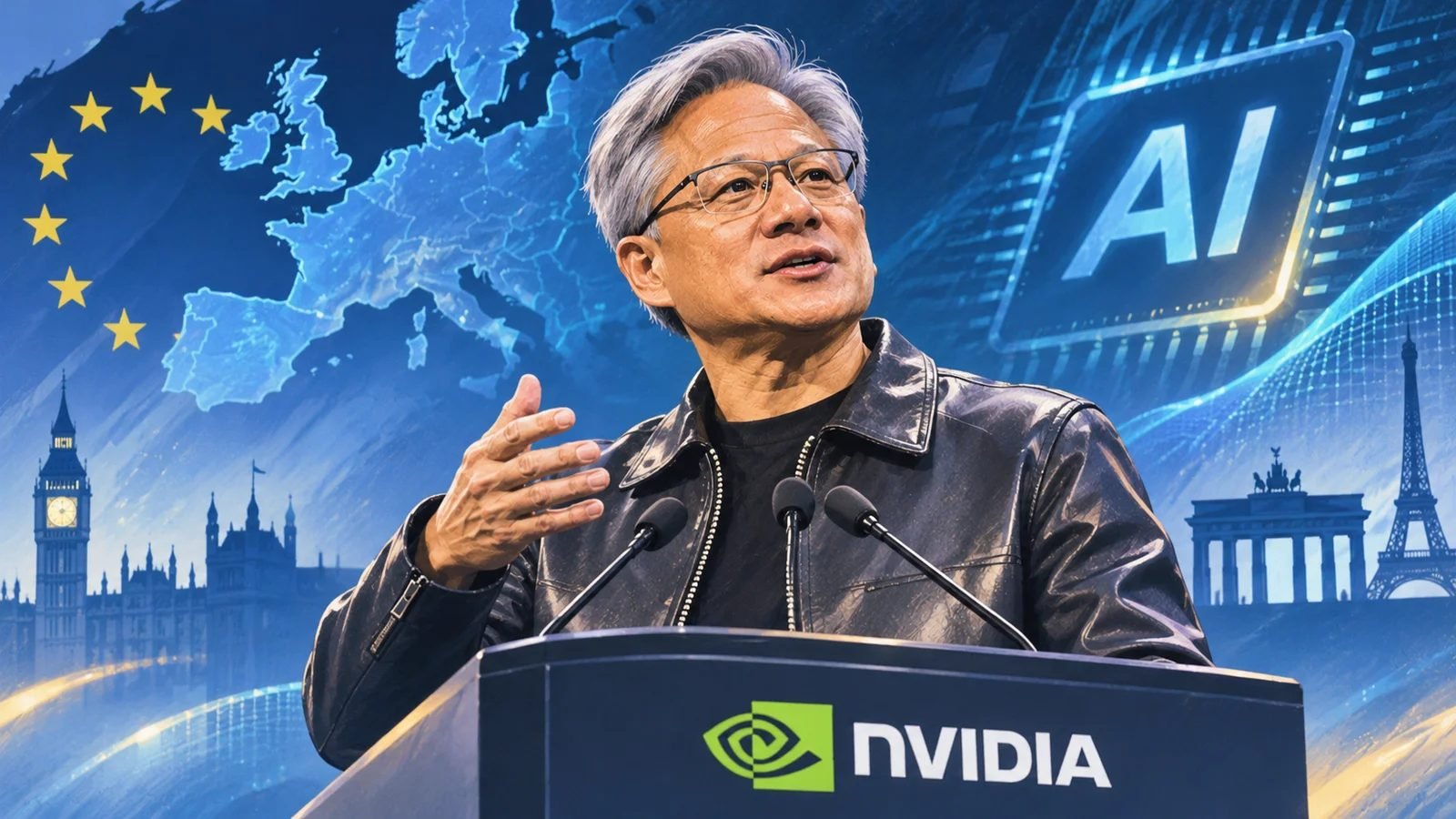
Jensen Huang recently offered Britain some unusually direct advice.
The NVIDIA founder and CEO praised the country’s universities, intellectual strength and technological talent. Britain, in his view, possesses many of the ingredients needed to succeed in artificial intelligence.
But he also identified a problem.
“If there was a million ways to win, you find the one reason not to do it,” Huang said. “I think you overthink things.”
Days later in Berlin, speaking alongside German Chancellor Friedrich Merz, Huang delivered a similar message. Germany already possesses extraordinary industrial knowledge, engineering expertise and manufacturing capabilities. Rather than reinventing its economy, it should use AI to strengthen what it already does well.
“Take advantage of the technology,” he urged. “It’s a new instrument.”
Huang was addressing Britain and Germany, but his remarks raise a much larger question.
Europe possesses world-class universities, scientific talent, industrial expertise and substantial financial resources. Yet it has fallen behind the United States and China in frontier AI development.
Why has a region with such considerable advantages struggled to keep pace?
Europe Has the Resources. What Is Missing?
The gap is increasingly visible.
According to Stanford University’s 2026 AI Index, private AI investment in the United States reached approximately US$285.9 billion in 2025, compared with US$20.9 billion in Europe.
Private investment does not capture the full picture, particularly in China, where state-supported investment plays a significant role. Nevertheless, the technological landscape is revealing.
The United States remains the leading centre of frontier AI development, while China has rapidly narrowed the performance gap and emerged as its principal competitor.
Europe has considerable strengths in AI research and specialised applications, but it has not achieved comparable scale at the technological frontier.
This cannot be explained simply by a shortage of resources.
Britain has Oxford, Cambridge and Imperial College London. Germany possesses one of the world’s most sophisticated manufacturing economies. France has exceptional strengths in mathematics, engineering and computer science.
Europe’s challenge lies in translating these advantages into technological leadership.
Fragmented markets, slower commercialisation, infrastructure constraints and regulatory complexity have made rapid scaling more difficult.
Huang’s criticism of Britain’s tendency to overthink captures part of this challenge.
Europe has devoted considerable attention to AI’s risks and regulatory implications. Those discussions are necessary, but technological development does not stop while governments deliberate.
In AI, Being Late Is Particularly Expensive
Artificial intelligence differs from many conventional industries because technological progress can reinforce itself.
Better models improve software development. Greater computing capacity enables more experimentation. Falling costs encourage wider adoption. Successful applications attract investment, talent and further innovation.
These advantages accumulate.
Stanford’s 2025 AI Index estimated that the training compute used for notable AI models had been doubling approximately every five months.
Meanwhile, the cost of using models delivering roughly GPT-3.5-level performance fell from US$20 per million tokens in November 2022 to just US$0.07 by October 2024.
These figures illustrate how quickly the technological environment can change.
In conventional infrastructure development, beginning five years later may simply mean completing a comparable project five years later.
In AI, the situation is different.
A country entering the market later faces competitors that have already accumulated technological capabilities, operational experience, investment and commercial networks.
Starting five years late can mean considerably more than being five years behind.
The frontier itself keeps moving.
The Leaders Are Not Waiting
Europe has recognised the challenge.
The European Union’s AI Continent Action Plan seeks to expand computing infrastructure and accelerate AI development. Its initiatives include 19 AI Factories being established across Europe and a programme for up to seven AI Gigafactories.
Britain has introduced its AI Opportunities Action Plan, while Germany increasingly views industrial AI as essential to its competitiveness.
These are substantial initiatives. But Europe is attempting to catch up while its competitors continue accelerating.
The United States has made its ambitions explicit. The Trump administration’s America’s AI Action Plan, released in July 2025 under the banner of “Winning the AI Race”, identifies more than 90 federal actions covering innovation, infrastructure and international technological leadership.
China is pursuing a different approach.
Its latest Five-Year Plan prioritises AI development, computing infrastructure and technological innovation. The country’s broader “AI+” initiative seeks to integrate artificial intelligence across industries and public services.
The American and Chinese systems differ considerably.
The United States relies heavily on private technology companies, venture capital and market competition. China combines commercial innovation with state planning, infrastructure investment and industrial coordination.
Yet both recognise AI as a strategic technology extending far beyond the digital economy.
Neither approaches it as a development that can be postponed indefinitely.
Accelerating is not necessarily enough when competitors are accelerating faster.
Regulation Is Necessary. Paralysis Is Not.
Europe’s regulatory approach inevitably forms part of this debate.
AI creates genuine challenges involving privacy, employment, cybersecurity, intellectual property and increasingly autonomous systems. These risks require effective governance.
However, regulation should not be confused with technological strategy.
Europe is not necessarily behind in adopting AI. Stanford’s 2026 AI Index reports that 91% of surveyed European organisations used AI in at least one business function in 2025, slightly above the corresponding figure for North America.
The real challenge is whether Europe can translate research, adoption and industrial expertise into globally competitive AI companies and infrastructure.
Regulatory uncertainty can complicate this process, alongside fragmented capital markets, limited computing resources and difficulties scaling businesses across national borders.
The answer is not to abandon regulation. It is to ensure that governance, investment and technological development advance together.
Otherwise, Europe risks developing sophisticated rules for technologies increasingly developed elsewhere.
The Warning Extends Beyond Europe
Huang’s message has implications far beyond Britain and Germany.
If economies possessing Europe’s resources struggle to compete at the technological frontier, the challenge is even greater for developing countries.
Many lack the computing infrastructure, research funding and specialised talent needed to develop frontier AI models.
But technological leadership and technological adoption are different questions.
Developing economies do not necessarily need to build their own frontier models. They need the institutional capacity, infrastructure and skills to use existing AI technologies productively.
For countries such as Sri Lanka, becoming an effective adopter of AI may be more economically valuable than attempting to compete directly with the world’s largest AI developers.
However, adoption requires experimentation, institutional flexibility and a willingness to change established practices.
Countries that cannot tolerate unsuccessful experiments may ultimately conduct fewer experiments—and discover fewer opportunities.
Thinking Must Lead to Action
Europe still possesses enormous advantages. Its scientific institutions, industrial capabilities and financial resources provide a substantial foundation for future AI development.
But potential should not be confused with leadership.
The United States and China increasingly treat AI as central to technological competitiveness and national development. Europe is responding, but it must close a gap while the technological frontier continues to move.
For developing economies, the lesson is equally important.
Waiting until AI becomes completely mature, predictable or risk-free may appear prudent. But the technology will not stop developing while governments decide how to respond.
Huang’s criticism was directed at Britain.
The warning is much wider.
The greatest danger for countries already behind in AI may not be moving too fast. It may be moving cautiously while those ahead of them move faster.
Cover image: AI-generated illustration.