
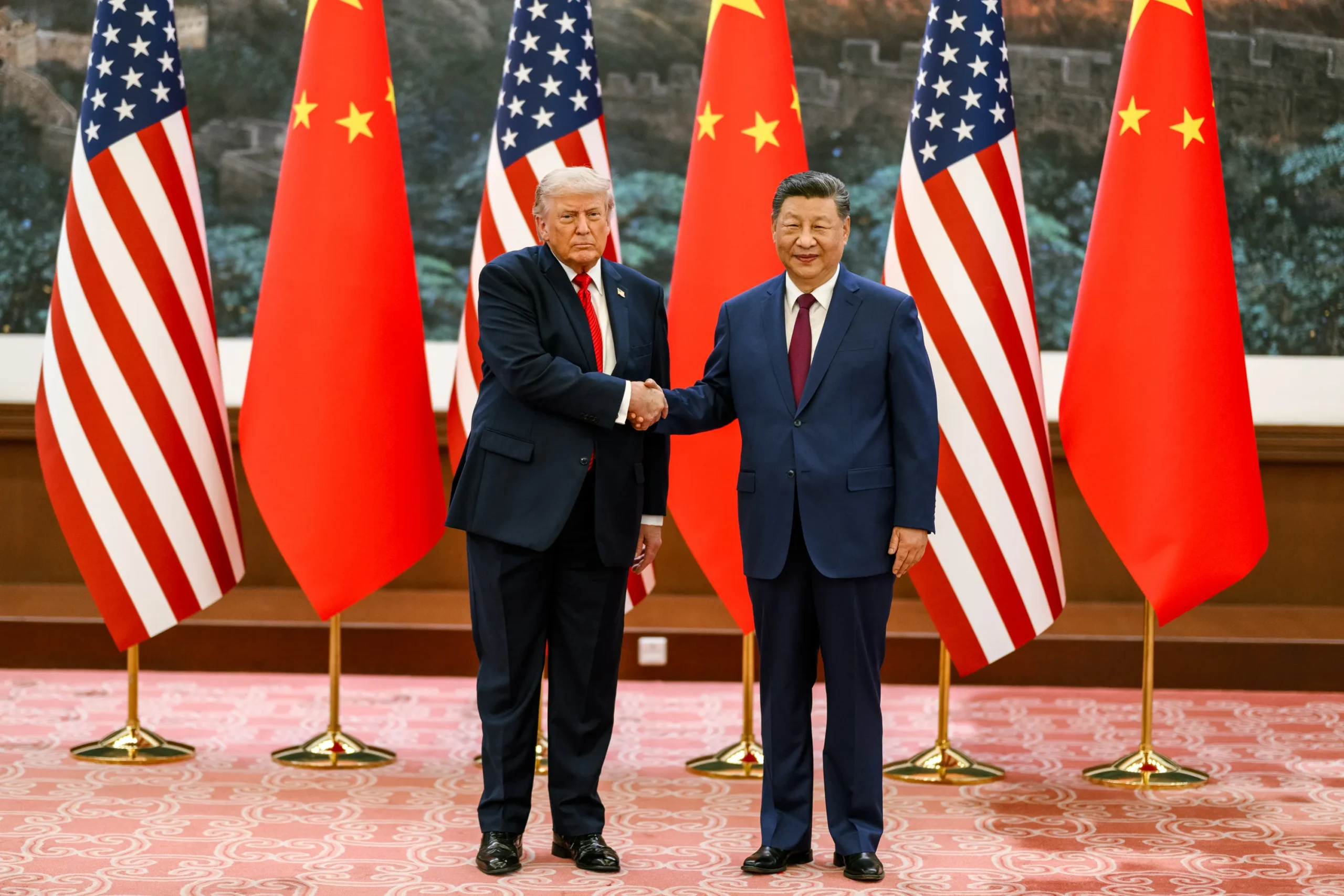
When President Xi Jinping met President Donald Trump in Beijing in May 2026, he posed a question that has preoccupied scholars of international relations for years: can China and the United States avoid the Thucydides Trap?
The question carries particular weight because relations between the world’s two most powerful countries have increasingly been interpreted through the lens of great-power rivalry. China is commonly described as the rising power, the United States as the established power, and strategic confrontation as the danger created by the changing balance between them.
But the recent evolution of China–U.S. relations suggests a more complex picture.
When President Xi visited the United States in September, the two countries reaffirmed their commitment to building a constructive relationship of strategic stability. They reached agreements involving trade, investment, artificial intelligence and communication mechanisms. Both leaders also recalled the history of China and the United States fighting as allies during the Second World War.
None of this means that strategic competition has disappeared. China and the United States continue to have important differences and competing interests.
But these developments challenge the increasingly fatalistic assumption that competition between an established power and a rising power must ultimately define their entire relationship.
This is why the Thucydides Trap deserves another look.
A Warning, Not a Prediction
Graham Allison’s original argument is more nuanced than it is sometimes presented.
The Thucydides Trap describes the dangerous dynamics that can emerge when a rising power threatens to displace an established one. Changes in the balance of power can generate fear, mistrust and miscalculation, increasing the possibility of confrontation.
Allison examined 16 historical cases of such power transitions and found that 12 resulted in war.
Yet his argument is not that war is inevitable. The central purpose of his work is to understand the danger so that it can be avoided.
The distinction is crucial.
The problem is not necessarily Allison’s theory. It is what happens when the Thucydides Trap becomes a convenient shorthand for an inevitable China–U.S. confrontation.
China is not Athens. The United States is not Sparta. And the international environment in which they interact bears little resemblance to ancient Greece.
Historical analogies can help explain international relations. But they cannot determine the future.
The mistake is to turn a warning into destiny.
China Is More Than a Rising Power
There is another limitation in applying the Thucydides Trap too mechanically to China–U.S. relations.
China cannot be fully understood through concepts derived from Western historical experience alone.
From China’s perspective, its development is closely connected to national rejuvenation—the restoration of prosperity, strength and international standing after a long historical period marked by decline and foreign intervention.
This historical consciousness matters when interpreting China’s understanding of itself and its relationship with the outside world.
Describing China simply as a rising power therefore captures only part of the story.
China can also be understood as a returning great power.
For centuries before the Opium War in the nineteenth century, China occupied a central position in East Asia’s political, economic and cultural order. The subsequent period of foreign intervention and national weakness, commonly understood in China as the Century of Humiliation, profoundly shaped the country’s modern political consciousness.
From this perspective, China’s contemporary development is not simply about acquiring greater international power. It is also about national rejuvenation and restoring its historical standing.
This does not eliminate the concerns that China’s development may create for other countries.
But it suggests that interpreting China’s intentions exclusively through the familiar Western framework of a rising power challenging an established hegemon may overlook an important dimension of its historical experience.
China’s understanding of its own development deserves to be considered alongside the structural changes taking place in the international system.
Interdependence Changes the Calculation
The limitations of historical analogy become even clearer when we consider the economic relationship between China and the United States.
Globalisation has created a degree of interdependence that did not exist in the historical cases normally associated with great-power transitions.
China and the United States compete strategically, but they also remain deeply connected through trade, manufacturing, investment, technology, supply chains and consumer markets.
This changes the calculation.
Economic interdependence does not eliminate competition. Nor does it guarantee peace.
But it raises the costs of confrontation and creates powerful incentives to keep the relationship functioning.
The evolution of the debate over decoupling illustrates this reality.
For several years, decoupling occupied a prominent place in discussions about China–U.S. relations. Restrictions on advanced technologies, investment and sensitive supply chains remain important elements of the relationship.
Yet the official statements surrounding President Xi’s September visit presented another dimension.
The emphasis was on strategic stability, reciprocal economic arrangements, continued dialogue and practical cooperation.
The two countries also established a bilateral dialogue on advanced artificial intelligence and agreed to strengthen communication concerning related incidents.
These developments do not mean that decoupling pressures have disappeared.
They demonstrate something more important: even amid strategic competition, both countries continue to recognise the need for engagement.
China and the United States remain deeply connected to one another and to the same global economy.
Neither can simply disregard the consequences of the other’s actions.
Competition Does Not Have to Mean Confrontation
President Xi’s formulation of competition during his September visit is particularly relevant.
He argued that China and the United States need not avoid competition, but that competition should remain healthy and bounded.
Rather than a zero-sum struggle in which one side succeeds only through the other’s defeat, he described competition as a process through which both countries could seek to improve themselves.
During President Trump’s earlier visit to Beijing, President Xi had also argued that the great rejuvenation of the Chinese nation and the American aspiration to Make America Great Again need not contradict each other.
That proposition goes directly to the heart of the Thucydides debate.
If China’s rejuvenation is automatically interpreted as America’s loss, and American strength is automatically interpreted as an obstacle to China’s development, almost every interaction between the two countries can be understood through zero-sum logic.
But that is a political interpretation, not a historical inevitability.
President Trump also placed emphasis on the history of China–U.S. cooperation.
During the Second World War, China and the United States were allies fighting against their common enemy, Japan.
This historical experience reminds us that China–U.S. relations have not always been defined by rivalry. Countries with different political systems and historical experiences can find common ground when their interests converge.
Indeed, the relationship has taken many forms.
China and the United States have been wartime allies, adversaries, partners in strategic cooperation, major economic partners and, more recently, strategic competitors.
Their relationship has changed repeatedly as international circumstances and national interests have changed.
There is no historical reason to assume that its present form must become permanent.
Beyond the Cold War Analogy
The Cold War analogy remains attractive because it is simple.
Two great powers compete. Their interests diverge. The international system gradually divides around them.
But contemporary China–U.S. relations are considerably more complicated.
Decades of globalisation have connected their economies in ways that make a straightforward reproduction of Cold War bipolarity difficult.
The two countries compete in advanced technology, international trade, security and global influence. Yet they also share economic interests and responsibilities concerning international stability.
The September agreements illustrate this complexity.
The two sides reaffirmed their commitment to a constructive relationship of strategic stability while establishing or advancing mechanisms for economic engagement, artificial intelligence dialogue and communication.
These agreements do not represent the end of competition.
They represent an attempt to manage competition without allowing it to consume the entire relationship.
That may ultimately be the more useful way to understand China–U.S. relations.
Competition and cooperation are not mutually exclusive.
Strategic differences can remain while economic engagement continues. Competition can coexist with dialogue. Disagreements can be managed without automatically turning into confrontation.
The challenge is not to eliminate competition.
It is to prevent competition from becoming uncontrollable.
The Importance of Leadership
The recent evolution of China–U.S. relations offers grounds for cautious optimism.
The future remains uncertain. Strategic competition will continue, and disagreements over economics, technology, security and international affairs will not disappear.
But uncertainty makes rational decision-making and direct communication between the two leaderships even more important.
Engagement should not be mistaken for weakness.
When two countries possess enormous economic power, advanced technologies and formidable military capabilities, sustained communication is an essential instrument of strategic stability.
President Xi and President Trump’s recent engagements demonstrate the value of such communication.
Direct discussions allow both sides to clarify intentions, understand concerns, identify common interests and reduce the possibility that manageable disagreements become unnecessary crises.
The agreements reached in May and September suggest that both leaderships recognise the importance of maintaining a functioning relationship despite their differences.
This does not guarantee future stability.
But it creates opportunities to manage competition through political choices rather than allowing structural pressures alone to shape the relationship.
That is precisely where leadership matters.
The Future Is Not Predetermined
Returning to Graham Allison brings the argument full circle.
The real lesson of the Thucydides Trap is not that China and the United States are destined for war.
Allison himself does not make that claim.
His theory is valuable because it warns of the dangers that can arise when changing power relations are poorly managed.
The Thucydides Trap should remain a warning, not a destiny.
China–U.S. relations are too complex, too interconnected and too consequential to be understood through fatalism.
Their future will not be determined by an analogy drawn from Athens and Sparta more than two thousand years ago.
It will be shaped by decisions made in Beijing and Washington today.
That is why the recent evolution of China–U.S. relations offers grounds for cautious optimism.
Competition will remain. Differences will remain.
But so will common interests, economic interdependence and opportunities for direct engagement.
The challenge for China and the United States is not to escape competition. It is to ensure that competition does not determine their destiny.
Cover photo: Daniel Torok / The White House
